
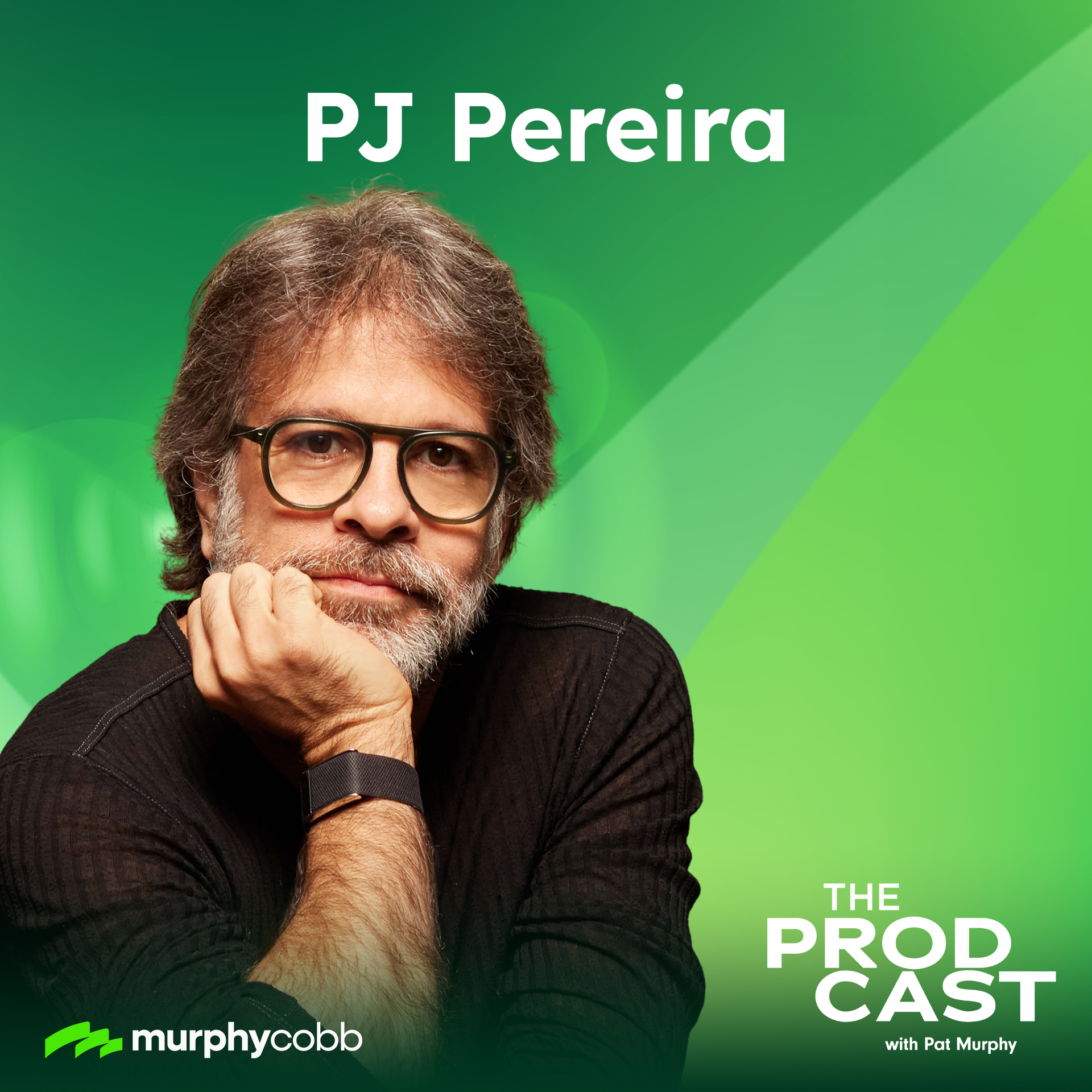
PJ Pereira
Pirates of Thought: Creativity, AI and the Human Edge
— Watch the Episode
— Show Notes
Pirates of Thought: Creativity, AI and the Human Edge
This week on The MCA Prodcast Pat Murphy is joined by PJ Pereira, co-founder and Creative Chairman of Pereira O’Dell and founder of AI-first creative lab SilverSide. A Brazilian-born creative leader, martial artist and novelist, PJ has spent three decades at the intersection of storytelling, technology and innovation. His branded entertainment series The Beauty Inside for Intel won a Daytime Emmy and remains one of the most influential pieces of branded content ever made.
PJ details his creative philosophy rooted not in advertising, but in programming, writing and martial arts. As a shy kid in Brazil, all three felt like different expressions of a single impulse: subversion. Whether writing code with features it wasn’t supposed to have, or pitching ideas that broke every rule, PJ’s driving question has always been the same: how can I do this in a way it was never supposed to happen? He also reveals how he splits his identity deliberately across platforms: LinkedIn for business, Instagram for martial arts, TikTok for fiction, and why that discipline of detachment from a single label has kept him genuinely excited about advertising for 30 years.
PJ is an AI optimist, but a specific kind. He argues that the industry is fundamentally misreading what AI is for. It isn’t an efficiency tool – it’s an ambition unlocker. He describes a client who killed a script for being too expensive, only for that same idea to be resurrected three months later when the technology caught up; and how AI now makes it possible to pitch the boldest idea alongside the safe one, because you can now afford to do both. On young talent, he’s equally direct: the story that AI has deleted entry-level jobs is, in his words, a lie – a convenient narrative invented by executives to justify mismanagement. At SilverSide, 22-year-olds in their first advertising job are already writing scripts and directing films.
PJ also opens up about growing up in a religious cult in Rio de Janeiro, and how the experience gave him his ‘maybe’ creative philosophy – the belief that every idea deserves genuine consideration, regardless of where it comes from. He connects this to the human skills he believes will outlast the AI revolution: memory, emotion and taste. Not people skills in the conventional sense, but the capacity to read an AI’s infinite output and say, with conviction, “this is the one.” We can only do that, he argues, because we have fallen in love, been afraid, and had our hearts broken. The silicon chip will never understand what hunger and heartbreak is.
See PJ’s favourite ad: The Independent – Litany
Hosted by Pat Murphy
Connect with Murphy Cobb and The Prodcast:
Murphy Cobb & Associates | The MCA Prodcast | LinkedIn | Instagram | Email
— This Week's Guest
PJ Pereira
Founder and Creative Chairman - Pereira O’Dell
— PJ's Favourite Ad
The Independent - Litany
— Full EPisode Transcript - Expand to read and search
— Full EPisode Transcript - Expand to read and search
Pat Murphy
Hi, and welcome to The Prodcast, your fix for everything innovative in advertising production. I’m Pat Murphy, and I’ve been working in this industry for more than 35 years now. I’ve seen a lot of changes, but know there’s plenty more around the corner. Each week on the podcast, you’ll get to hear from one of the movers and shakers who are shaping the world of advertising and production for the future and we’ll dive into some of the key challenges facing our sector today and how we’re best placed to overcome them.
Today’s guest is someone I’ve been looking forward to very much speaking with. PJ Pereira is one of the most original creative minds in our business, a Brazilian-born creative leader, entrepreneur, writer, and co-founder of Pereira O’Dell in San Francisco and now AI-first agency SilverSide. He’s built a career at the intersection of storytelling, technology, and innovation, creating work that hasn’t just won awards, but has genuinely shifted the conversation around what branded creativity can be. From landmark projects like The Beauty Inside through to his broader thinking on AI, narrative, and human behaviour, PJ has always struck me as someone who sees around corners a bit, which makes him the perfect guest for our conversation today about where creativity is heading, what AI means for talent and clients, and whether our industry is evolving or just getting better at pretending it is.
PJ, benvindo ao Prodcast.
Let’s start at the beginning then. Programmer, storyteller, creative leader – that’s not the usual route into advertising. What did that early coding mindset teach you that still shapes how you work today?
PJ Pereira
So it’s funny, because I remember my first job in advertising. I’ll go forward so I can go back. My first job in advertising, my first agency — I ended up, after a while, getting fired from every department. They’re like, ‘Yeah, you’re kind of cool, but you don’t belong here.’
Pat Murphy
There’s two of us. I got fired as well from every agency! So it’s no problem.
PJ Pereira
So they kept firing me from the departments and eventually I ended up at Lenny on the creative department. And they finally asked me, ‘So are you a writer or an art director?’ And I said, ‘I’m a programmer.’ And it’s like, ‘Oh, you don’t belong here.’ No, no — do I really need to pick one? But yeah, okay, then I’m a writer. But I was a programmer. The thing for me is that when I was a kid, I was always a shy kid that liked to stay in the corner. I always had more fun in my own head than talking to other human beings. So I liked the quietness of my head, or the loudness of it. But I was always in the corner by myself, either writing or drawing or programming on a computer. For me, those three things were exactly the same. They were just expressions. And what I didn’t know at that time — at that time it was just like, ‘Yeah, those are just fun things that I like to do’ — but what it actually was is that I was being creative, I was enjoying being creative. Later down the road, I started to enjoy martial arts as well, and way further on I got into advertising when I was in my early 20s. But before that, it was drawing, writing, programming my computers. And for me, they’re all the same thing. And so the combination of those three things always got me to thinking about: what is new out there? How can I hack it? And I didn’t have the words for that, but the play was always — has always been, since I was a kid — how can I do this in a way that it was not supposed to be happening? How can I subvert this in a way and write stories with characters that are not supposed to be there, or make drawings in ways that are not supposed to be drawn, or program things with features that were not supposed to be? Subverting those original intentions has always been my thing. So that created a discipline of always trying to know what’s next, just so I can mess with it.
Pat Murphy
But all of those skills – you sitting in the corner playing with things and technology and stuff – has played very much into the role that a creative director has today. Would you call yourself a creative technologist?
PJ Pereira
I have called myself that multiple times, and I’ve seen people say, ‘No, no, no. You’re a creative director. Creative technology is a smaller thing.’ No, it’s not smaller. And it’s just smaller because art directors and writers want to say that they’re more important than technology people. I come from technology. That’s my creative background — it’s really technology. The writing and the art direction came later. I write novels, so I actually write more in-depth stuff than advertising people write, but I’m actually a tech person.
Pat Murphy
I was going to ask you about your novels. And you do that under a different name as well. Do you have any other personas?
PJ Pereira
I have my martial arts. It’s funny because social media forced me to have a little bit more clarity on that. I just split my social media profiles in very different facets of my life. So my LinkedIn profile is my business – a lot of AI things happen, conversations happen on LinkedIn. On Instagram, I am a martial artist. I only talk about martial arts. On TikTok, I only post as a novelist. So it’s a mix of different things. And it’s fun to be able to turn off one part of your brain and go, ‘Okay, now I’m this.’ I think we’re so associated with our own identity — you know, the handshaking task: you go to a party and introduce yourself. ‘So I’m PJ, I’m a…’ and that first thing you say is usually what you tell yourself your identity is. And the problem is that eventually you get sick of it, and then you get sick of yourself and you lose sense of who you are. I’ve been trying for the last 20 years almost to detach myself from that handshake, so I can apply more longevity to all those facets, to all those parts of my life. Because I think that the reason why I’m still excited about advertising is because I’m not just an ad guy.
Pat Murphy
Oh, I completely agree with you. I’ve always had parallel careers going on. Even when I’ve been working in ad agencies, I’ve always worked at radio stations as a DJ at the same time. You try and fit it in, but you know what? I just loved being in the business. It didn’t matter whether I was in a radio station or sitting in a recording studio or sitting in a video edit suite or being in the agency. I just loved it.
PJ Pereira
It’s good to be in a business because you’re excited about it, not because you don’t have any choice.
Pat Murphy
Correct. Exactly right. Now it causes me a problem, I’m interviewing you because I don’t know which direction to go down. Let’s talk about your books. PJ Caldas – is that your name?
PJ Pereira
Yes, that’s my pen name. In the US. In Brazil, I still sign my books as PJ Pereira, but the problem is that after 20 years in America having an agency called Pereira O’Dell — if there’s one thing that I’ve learned, it’s that Americans cannot spell Pereira. They just put the ‘i’ in different places. It’s just impossible. So I thought, you know what, I’m going to try a different name. Caldas is easier for them to spell, so I’ll be less punished by Google and searches on Amazon. I tried that. But I still don’t know if it’s a good idea. I’m still judging it.
Pat Murphy
And what are the books about? They’re not how-to books in advertising — they’re novels, yes?
PJ Pereira
Yeah, they’re novels. The books always have to do with something very old and something new. So my first books were about African mythology – which is very important in Brazilian culture – and the internet, and the rise of the internet in newsrooms. That was the story and the conflict in the story. The newer book that I published two years ago is called The Girl from Udang. It’s about artificial intelligence and kung fu and MMA – artificial intelligence and martial arts. I have to maximise time.
Pat Murphy
You talk about martial arts though, PJ. Are you talking about the whole gamut of stuff, or are you just talking jujitsu or kung fu? Do you have a particular area of specialisation?
PJ Pereira
I’m old enough to have tried everything you can imagine. So I started fighting when I was like eight, nine, ten years old. My father was a judo black belt. I talked to a client of mine who produced a very important TV series about martial arts called Why We Fight. I asked him, ‘So why do we fight? Because I’ve been fighting my entire life.’ He said, ‘No, it’s always because of someone else.’ And I said, ‘Damn, I did it because of my father.’ And now I’ve been doing therapy about that for the last month, just because of that conversation. My father was a judo black belt. I decided to do that because of him, and then I have a son. My son enjoys martial arts now, and now I do it because of him – because I want it to be our connection. But martial arts is – other than family – the most important part of my life.
Pat Murphy
And you’re a black belt as well, yes?
PJ Pereira
I have three black belts, and I’m working on my fourth one, and there are other things that I can use as well that don’t have belts.
Pat Murphy
So no one messes with you in the agency, I guess.
PJ Pereira
I’m old enough to be messable, but I can hurt people.
Pat Murphy
So was there a moment early on when you realised that creativity wasn’t just about making things, but about shaping how people believe, feel, and behave?
PJ Pereira
You know what? I still don’t know, I go back and forth. The truth of the matter is that there was a part of my life where creativity was a fun thing. Like, I just liked to watch movies, read books, create stuff – it’s just that impulse to create. Then there was a moment that I started to treat creativity as a problem-solving tool, a way of thinking. And for a long time, every time someone asked me, ‘What is your definition of creativity?’ I liked this idea that creativity is the opposite of logic. Logic – you take a problem, you build in the most efficient way a path to a solution. And then creativity is the opposite of that, in a sense: it’s a very inefficient way of thinking where you just throw solutions at the wall and see if something sticks, which makes it very upsetting, because you’re going to have your heart broken more often than not. You’d have to be bold, because you’re going to face-plant a lot. But it’s fun as well. But recently I decided to think that that may be wrong. I was at a book launch event a couple of years ago in San Francisco, talking to readers. An old woman raised her hand and said, ‘I’ve been reading about your book, I’m really curious about it. I like the story, but — your next book is it going to be written by AI? Because I don’t want to read a book by AI.’ And that shook me to my core. It took me a while to understand why. It was nerve-wracking because I was in front of an audience and everyone is looking at me – I have to say something. So I said, ‘Give me a second,’ and then I looked back and said, ‘I can promise you that my next book is not going to be written by AI. And this is the reason: I’m not writing because I want to solve a problem. I’m not writing because I want to put a product on the shelf. I’m not writing because I have a business plan. I’m writing because I have a story in my head that if I don’t let it out, I’ll die.’ And that’s when I realised that, for as much as we think creativity is this thing that we do as a way of solving problems and moving people, I think we’re overcomplicating it. Creativity is just an impulse — it’s something that we have to get out because we have stuff in our heads, and if we don’t do it, we die. And the most amusing thing – the reason why people get so fascinated by that – is the same reason why people get fascinated by astronauts, by UFC fighters, by pirates. It’s because those are people who put their bodies at risk in ways that you wish you had the guts to do, but you don’t. Creativity is just the intellectual version of that. It’s the brain version of: I can get stabbed, I can get punched in the face, I can die. Once you put an idea that has never been done out into the world, you allow yourself to get your whole identity shattered and destroyed, and that’s dangerous. Everyone knows – you say something as a kid, someone looks at you and laughs at you, and then you never again try a different idea in your life. Very few of us end up feeling like, ‘Okay, that’s fun.’ The same way that very few of us decide to go in front of someone else, risking being punched in the nose – it’s not for everyone. And I think that’s the value of creativity. It’s amusing for most of the world to feel like, ‘Oh, there’s a human being on the other side who decided to take that risk.’ That’s why when I see all this discussion about AI, and people feel like, ‘Are we going to destroy creativity with this? Because now computers are going to create stuff?’ No, we won’t. Because the amusement behind creativity – the reason why creativity is so important for culture – is because we’re just pirates of thought. People like to think there’s someone doing that, and the romantic side of it: this person did it and is trying. The moment it’s a robot having that idea, it loses the amusement. There’s no value behind it.
Pat Murphy
Well, ‘pirates of thought’! I think I’m going to nick that one.
Well, let’s rewind, PJ. Back to 2012. The Beauty Inside was an incredible branded project you did with obviously a very brave client at that time with Intel. And I’ve been watching all of the episodes that you created. They are absolutely beautiful. Do you think you set a standard for branded entertainment at that time?
PJ Pereira
I don’t know. I’ve never tried to set a standard. The joy of it, the fun of it for me, is the subversion of it. It’s like trying to do things in a way that they’re not supposed to happen. So the idea of setting a standard is a little bit counterintuitive for me. I don’t want to set a standard, I don’t want anyone to follow the rules. I think the most fun is looking at something and using it in the wrong way. So what we were doing back then is: the story is supposed to be told by the writer. And we were asking ourselves, ‘Imagine this character that wakes up in a different body every day’ – which is a little bit of subversion of the story, but it’s not the first time you start from a wild assumption. The wild part there was that, ‘okay, if this character wakes up in a different body every day, what if we relinquish and release control from the hands of the writers and give the audience a chance to play the character and write the character’? What if we just ask them: ‘Hey, this character woke up in your body. Play that. Record a video of you as Alex.’ And we got some of the most heartbreaking and entertaining things. There was one guy that wrote to me: ‘I woke up today and I have cancer. I don’t know if I’m going to survive this time.’ And there was a woman who said, ‘I woke up today and I’m pregnant. What’s going to happen to my baby tomorrow?’ I have chills thinking about this. Those are things that people were doing because we gave them a way to participate in the story that we had no idea about. It’s thrilling, but it’s scary as hell. All of a sudden you lose control of your character. And I think that’s where the piracy happens: you allow yourself to completely lose control, or try things in ways that they’re not supposed to happen. I don’t know where my stories are going to end when I start. The characters live in my head and they determine things that go beyond my intentions. Well, it’s part of the fun, it’s part of the thrill. The same way that when I walk into the octagon, or step on the mats, I don’t know if the person in front of me is going to choke me to sleep or break my arm or break my teeth. But I’m game. I’m fine with that.
Pat Murphy
Now, I watched the first couple thinking, ‘Okay, I’ll get an idea of what it’s about. I won’t need to watch all of them.’ How wrong I was. You know, that character of Alex – after the first couple, I thought I had to watch the whole lot. And when you originally showed them, people had to wait every week for the new one to come out. It’s like watching incredible drama, and you’re on tenterhooks for another week. And you won a Daytime Emmy for that as well. It’s an incredible piece of work. I absolutely loved it.
PJ Pereira
No, thank you. That was the second of a series of four different movies. We did a social media piece of entertainment – a social media series or movie – in four different genres. The first one was a thriller, the second one was a fantasy romantic story, then the third one was humour, and the fourth one is a really fantastic story. But The Beauty Inside almost didn’t happen. The story behind it, that very few people know, is kind of cool. We had a thriller. The story was for Intel. The main thought there is that Intel is all about what’s inside. So let’s do a series of films, because consumers – especially at that time – mostly used their computers for entertainment and social media. The mobile phone was the device for social at that point. How do we combine entertainment and social media at the same time? We created this concept: let’s do a thriller first. A girl wakes up and she’s in a room and she doesn’t know where that room is, and she needs to use the audience’s… she has an internet connection in her computer, and she’s trying to use the audience’s advice to find clues to get out.
The client loved it. We found a really cool Hollywood director who does thrillers. Then one day we get a call from the client saying, ‘Oh, this is great, but we talked to Lego and they say it’s fine as long as the girl is not afraid for her life or facing any kind of violence.’ And the team calls me: ‘Oh my god, what do we do with that?’ So I said, ‘Let’s be honest about this. If they’re saying this, they’re saying they don’t want a thriller. Try to find a way to get a thriller where the main character is not afraid means the thriller is dead. Let’s just come to terms with it.
But we have a meeting with them to discuss the script tomorrow at 8am, and it’s already 4pm. What do we do?’ ‘Okay, I’m going to the office. Let’s talk.’ We go back: ‘Let’s talk about what we do with this idea in other genres.’ Fantasy. ‘Let’s talk about a romantic story here. What would that be?’ And then someone in the middle of that conversation says, ‘What if it’s a person that wakes up in a different body every day, but inside they’re always the same?’ Like, ‘Oh, that’s cool.’ And we started… ‘Well, what would the wardrobe be like?’ I remember that – the wardrobe question was the one that got us hooked. What would that wardrobe be like? You’d have to have shoes in all different sizes, with men’s and women’s clothes. And what if you’re old one day? What if you fall in love? Like, ‘Okay, now stop everything.’ We wrote that story. And the next day at 8am, we had the client in there: ‘Hey, you said you don’t want the person to be afraid. So it’s not a thriller. So here are four genres. There’s one that we really like.’ We sewed them into the idea of doing the story of The Beauty Inside. ‘Great. Yes! Awesome. We want to do this.’ So the thriller is dead then, right? ‘Can I suggest something? Do the thriller first.’ ‘Why?’ ‘Because a thriller is going to shock the world and make people feel: how is a brand doing a story about a woman afraid for her life? It’s not normal. That’s going to buy you credibility for the second one.’ And they said, ‘But what if it doesn’t work? Are you prepared to kill your brilliant idea because you think that the other one is a better start?’ And I said, ‘Yes.’
And I had to say yes with all the confidence in the world, because I believed it from an intellectual standpoint. And they said, ‘Okay, let’s do it.’ We signed and they left the building, and then everyone in the room looked at me and said, ‘What the fuck did you just do?’ And I said, ‘What I did is that I committed to what is right, and now we need to make the first one work. Otherwise, what’s possibly going to be the best work of our careers is going to be dead.’ So lets make this first one work!
We made it. It worked so well that at the last episode of the first one, it happened live with people walking in and a mystery happening in a train station in LA. At the ending, the client and I toasted at the bar there. And the client looked at me and said, ‘Wow, this one was so successful, it was so successful that I think we shouldn’t do The Beauty Inside anymore. I think we should do The Inside Experience Two.’ And I said, ‘No fucking way. Now we’re going to do that. You’re not going to do that to me.’ And we ended up doing it. Thankfully, I didn’t screw up that badly.
Pat Murphy
Incredible. So you built this incredible agency, Pereira O’Dell, with your partner Andrew Odell, who I’ve met a number of times now. Yet now you’re building a new style agency – or what you actually call an AI lab – called SilverSide. Why would you build a separate AI company rather than simply evolve Pereira O’Dell from within?
PJ Pereira
It’s a really good question. The short answer is that these things are moving way too fast for this operation to have to negotiate with the legacy. Even though Pereira O’Dell is faster than any other agency that I know, AI is still faster than Pereira O’Dell. So I wanted to have a structure that was completely independent, that didn’t have to negotiate with the past to change the future. That was the thought. There’s a longer version of this: I was in the industry when the internet was born. Actually, that was my ticket in. I was hired by my first advertising job to be the internet guy – I was the only person in the agency that had an email. And that was my job was to help the agency understand what the role of the internet in advertising was, because at that time it was just TV and print. And I realised very quickly back then that although there was a lot of value in doing things together, and I could see the future of digital and TV and print being done together because ideas were the same and consumers were the same, the structures of the traditional business — the way an agency was structured was too stiff to adapt to the new model. And that’s why the Razorfishes of the world, the Organics of the world, the KQAs and R/GAs were being born — because they had to be unbound from the rules of the current business model. And I thought, okay, I learned from that. Let’s create a separate business so we can understand what this new business is. And then as we evolve those two things, we can learn from each other, adjust each other based on what we are seeing, and then later down the road we can ask: are those two different things, or are they just going to become the same again? So I’m letting the world teach us how we want to be, instead of forcing it just because the business can’t flex in different directions.
Pat Murphy
And clearly SilverSide is proving to be a company shaking things up. I think you won the award for best breakthrough agency last year – was it Ad Age? And you’ve just opened up in London as well.
PJ Pereira
We’re trying our best to stay unbound.
Pat Murphy
Has SilverSide made you more optimistic about creative possibilities? Are you more aware of how broken parts the old model have already become? How do you feel about this new AI-native model?
PJ Pereira
Honestly, I was getting bored by advertising before AI happened. Because it was like, okay, I’ve been doing this for a while. I know how my day is going to be, how my week is going to be. I love my team. I really appreciate the trust of the clients. But the work itself – I know too much. For someone who is so obsessed about what’s next, it was getting a little too predictable. But then AI came and in a big irony, I got into it because of the novel. The AI is the villain, or the opponent of my main character. So I never got into it with the intention of liking it. I went into it with the intention of disliking it, of portraying it as a threat. And I did — in the book. For 10 years of research, all I did was discuss and study the threat. But then something happened. When we got really close to the launch of the book, that’s when Midjourney came out, when ChatGPT came out, and I started to feel like, ‘Oh, this is becoming a reality.’ I had started to study GPTs like two years before ChatGPT came to life, and I was playing with these ideas that have their own ideas – explaining what a concept is to the machine and watching it do its own variations, watching it get better with every version. Every six months something new would come up, and now it’s every week. When I started to play with it, I thought, ‘I’m going to do the book launch with it just to play with it,’ and then, ‘Oh, this is going to transform my business. It’s going to transform how I create things.’ So we created a lab within Pereira O’Dell and we started to play with that. And I felt, ‘Oh, this is not just going to be a little department. This is like the internet days – it may become a completely separate thing.’ So let’s create a separate company. And we did.
And that gave me the perspective that there’s a completely new way of thinking about creativity, that whether it’s a separate business or part of what you do, it’s going to transform the act of creating altogether. Because the same way that one day in the 70s, people had to learn how to create ideas that moved and talked because they were no longer just printed, and then in the late 90s and early 2000s, we had to discover that there’s a new kind of creativity that talks back and is interactive. I think now we’re about to discover a new generation. that feels to me – I’m not totally sure about it – but it feels to me that these are ideas that have their own ideas. If MasterCard’s Priceless was being created today, someone would be writing a format and then saying, ‘Okay, I think this is a format that can be replicated infinitely. I’m going to teach a machine how to do it, track what’s happening in the world, and give me ideas of scripts – things that are priceless – that I can say, ‘but for everything else, there’s MasterCard’. And every day I’d have something new. I would have the coolest TikTok thing ever, because now I have a machine that helps to make it. And I think that’s a wonderful thing – there’s a new category of creativity that we can explore as creative minds.
Pat Murphy
I completely agree. I’m actually an AI optimist. But then I was talking last week to a journalist who wanted me to provide some sound bites about what AI does for talent in the industry and how things are going to change, and the new talent coming into the industry. What kind of skills are they going to need to be successful and thrive? What do you think?
PJ Pereira
Listen, I have seen the reports about how AI has single-handedly deleted entry-level jobs. That’s a lie. Let’s start with this. That’s a lie. The jobs are going away, and the executives are saying it’s because of AI, but it’s a lie because no one deleting those jobs actually understands anything about AI. So they’re just doing a nice story to justify their mismanagement and to tell the shareholders that they’re doing something. But it’s a story about mismanagement, not AI. Let’s start there. The second part is: I get the logic – ‘Oh, now AI is going to do the simple things, and the simple things are what the interns used to do for the experienced people.’ Yes, that’s how it has been. I understand it. But I’m living in this life right now. When you look around, you see a bunch of 20-year-olds in their first job in advertising ever, and they are writing scripts and directing films at 22. At an age that, if you were producing any films, you’d be doing coffee runs. When I was 22, if I decided to direct a film, they would tell me, ‘You need to wait. You need to do 10 years of coffee runs and carrying cables around before you do it.’ They’re doing that already. So people who are saying the jobs are going to be gone for the young ones don’t have a clue. I’m seeing it. I’m telling you from the belly of the beast — that’s not what’s happening.
Pat Murphy
So what you’re actually saying is that when they’re coming into the industry, they already have all the skills because they’ve just been playing with this stuff before they come into the business.
PJ Pereira
It may be that, but I think it may actually be the opposite of that. They do not have the skills — neither do we. So I think there has never been a moment in history where the gap between the CEO of an agency and the intern has been smaller. We’re trying to say that’s bad for the intern, but that’s crazy. The smaller gap is bad for the CEO, not for the intern.
Pat Murphy
That’s a great way to look at it. That’s brilliant.
Look, my kids are early teenagers. If you were going to give advice to someone whose children were my age, coming up through their early years, what kind of skills do you think they should be learning now before they go out into the big wide world?
PJ Pereira
I’m a father, so that is the ultimate question that I have in mind. And that makes me very insecure. It’s the most difficult question I’ve been struggling with. So what do I tell my son? I think what I’ve been telling him – and this is as honest as I can be – is that you can’t afford to not seriously consider this and learn it. You have the right to be against it. You have the right to be an activist against AI and the future that these big tech corporations are trying to build. You can have a political opinion about the dangers of a world that is going to be controlled by seven people. I saw statistics today from a Nobel Prize-winning economist: each one of the seven big tech companies right now are bigger individually than the British Empire at its peak. So we’re talking about emperors, we’re not talking about CEOs. A gigantic amount of power and I don’t know if that’s a world or a political structure that I personally want. And I want my son to have an opinion about these things, but he cannot let his political opinion cause him to reject the skills that he needs to develop. The skills that he needs to develop are fundamental for his future. He’s in film school right now. He needs to learn how to do these things, even if it’s to one day decide that he’s going to reject it and become the filmmaker like Christopher Nolan who does everything practical. Yes, he can do that – but he’s Christopher Nolan. There’s only one Christopher Nolan. If he becomes Christopher Nolan, awesome! Good for him. But if he decides to be the next CGI wizard, or the next creator of Pixar, he wants to have those skills as well. And so I think the best advice is: develop the skills.
Pat Murphy
And what about human skills? There must be some things that AI can’t do. Human skills such as selling and negotiating and presenting and building human interactions, building rapport – those skills are going to become more important as time goes on.
PJ Pereira
I have very poor human skills myself.
Pat Murphy
I don’t believe that for a moment.
PJ Pereira
No, seriously. My wife is the opposite of me. She has incredible emotional skills. I’m married to a fairy. She’s like the most wonderful person. And I usually say that if I wasn’t married to her, I’d die alone, because all my friends would disappear, because I don’t have the skills to cultivate the relationships around me, just because I live too much inside my own head. It’s not a judgement or anything, it’s just a skill that I don’t have. I feel like people like her, with those incredible skills of getting around people and connecting – they’re going to be more valuable than ever. But I think there’s something still human in what I do that I think is going to be more important than ever as well. That is being in touch with your memories, with your feelings, with your comprehension of the world. If you look at the work that actors do – they act with their memories. They don’t act with the scripts. They don’t read and say, ‘Oh, now you look sad.’ I remember Matt Damon talking about The Rock’s performance in The Smashing Machine, and how touching it was – a specific scene where he reveals that he’s afraid, that he admits he has a drug problem, he’s scared. The Rock gave an interview about this moment. It’s so touching, and you don’t expect that from him. And he said, ‘I remember when my mother was at the hospital and she was told she had cancer – she pulled the sheets and hid for a second behind the sheets. That moment of trying to hide from something that she couldn’t – that’s the moment I pulled from my memory.’ Memory, and the setting, and the smells, and the tastes, and the fears – that’s what makes us human, and that’s what allows us to deal with machines that have infinite ideas and say, ‘Oh, that idea is really good. I want that. I’m going to take this line.’ It happened to me yesterday. I was working on something and I said, ‘AI, try something for me. I want to write something based on this,’ and I gave it a very complicated brief. It wrote a first draft of a manifesto that would have taken me a few hours struggling with the white page. It gave it to me, and it wasn’t really good, but there was one line there that was special. I thought, ‘Oh, that one line – I remember this. I have that memory, and I remember the feeling and the fascination I had with that moment. Let’s take this and turn it into something else.’ So I was directing the AI with my memories and my feelings. And I think that’s the human skill that is going to survive. Because there’s that thing people say: if you give an infinite number of monkeys a typewriter, one of them is going to write Shakespeare. But there’s going to need to be motherfucker there reading all the bunch of crap to see which one is the Shakespeare. We’re that one. We’re the ones reading the monkeys’ sayings and saying, ‘Oh, this is the Shakespeare.’ And we can only do that because we have fallen in love before, because we were afraid of death, because we’re taken by lust. Those human instincts are what define our humanity, and the machines are never going to have that. The silicon chip will never understand what sex and hunger or heartbreak is.
Pat Murphy
So that whole emotional thing – making people laugh, making people cry – that’s the real stuff where you can leverage your humanity in the creative process when working with AI. I think that’s amazing. But what do clients still most misunderstand about AI in the creative process?
PJ Pereira
I think it’s the fact that the whole world – and specifically clients – they’re looking at AI as a way to unlock efficiency. And I think that’s the wrong thing to do, because when you go deep enough, yes, it’s way more efficient than the traditional old ways. But that’s not where the benefit is. The real benefit is in how it unlocks ambition. As a creative mind, there are ideas that have been killed that I can now do. You know that typical thing where you bring three ideas to the client, you know they’re going to pick the safest, and you really struggle: do I even present the safest? Because it’s going to kill the best one. Now we can present all three and say, ‘Okay, I know this is the safest, this is the better one, this is the one in the middle. So let’s kill the one in the middle. Let’s do the safest and let’s do the boldest. And we can now afford to do both!’
I had a client a few months ago kill an idea because they told me, ‘Hey, this idea is my favourite. It’s brilliant, but it’s too expensive to make for the product that you represent. I’m not willing to spend that much money for this product. It’s fun for my brand, but the product itself doesn’t justify it. So no, thank you.’ End of discussion. Three months later, there was an update on how the technology worked. Now that spot that was dead can be done almost instantly. So we spent one week with a couple of people here doing it. I called the client and said, ‘Hey, I want to show you something.’ I showed the work done and I gave it to him. So now he can run it. And he ran it. It was incredible. So the idea that now we don’t need to kill a script or shelve it because it’s too expensive — that’s liberating. I think AI should be there. We should look at it as a way to unlock ambition, not to unlock efficiency. That changes everything!
Pat Murphy
That’s amazing. Look, we started changing the way clients looked at production models numerous years ago, including using virtual production, which we’ve worked a lot with three or four years ago. And now with AI, you’ve really taken the shackles off creativity. Everything is possible now with the technology. And I love that it’s about ambition now. That’s what it is. Unlocking ambition. Which I think is a brilliant way to look at it, rather than just about efficiency. Of course, it’s brilliant for efficiency – but it shouldn’t be the going-in position, I guess.
How do you personally deal with creative fear? Do you ever have that? Especially when you’re about to pitch something very audacious. How do you deal with that?
PJ Pereira
Man, I deal with that by going to the gym and getting a punch in the face. Because it both releases the stress and makes that fear seem silly. When I walk into a room to try to sell an idea, because of my life in the dojo, I feel so comfortable being uncomfortable. I remember – and this is not a metaphorical thing, it’s a true feeling – I remember being in a situation where I was talking to Andrew about something, and it was so stressful, and the tension was building. And then I looked at it and thought, ‘You know what? Yesterday I had a 300-pound person sitting on my chest. I could barely breathe. And all I could think was: can I hold three more seconds before the clock runs out?’ And I did. So I can handle that pressure.
I think that part of it is also having other creative outlets. Writing also helps me with that. There’s this guy who was obsessed with dogs called Cesar Millan, the dog trainer. And the trick with dogs is you have to get them exercised, because if they’re tired, they’re good dogs. I think our creativity is the same – if it’s exhausted, if it’s tired, it’s a good skill. If you come to work in advertising with all that bottled creativity that you have to express, the next assignment you see – the next blank page – you’re going to try really hard to exercise your creativity at the highest level. Sometimes your personal interests don’t match the client. Sometimes what the client needs is something very simple and fast that just solves the problem and he can move on to something that really matters to him. If when you look at that page with all your creative anxiety, you’re not going to be able to see what the client really needs. So for me, another way of dealing with my creative fear is not looking at the next assignment as my only outlet for my creativity. So when I write my books, I’m exercising my ability to write long arcs, which helped with things like The Beauty Inside, but also helps me feel like, okay, if a client kills my idea, I haven’t killed my creativity. I have this outside part that I can still do that is completely independent from my clients. Now when I look at a client, I’m just thinking about them and the problem they need to solve, and I’m going for that. When my creativity can help, it’s awesome! But if there’s something that just needs a simple one-plus-two-equals-three said, I’ll say it and I’m fine. I’ve been exercised enough to be a good dog!!!
Pat Murphy
And having other outlets, I think that’s such an important thing. This is one of my outlets, particularly as I’m not in a business that actually makes stuff. We’re in the business of advisory. So I wanted to have something where I could make something. And this Prodcast has been a great outlet for me for the last three or four seasons. We’re in season five now, of course.
One of the things that I’ve suffered from hugely since I’ve been in this business for the last 40-odd years is imposter syndrome. Sometimes I wake up and go, ‘How the hell did I get here? Somebody’s going to find me out one day.’ Did you ever suffer from imposter syndrome?
PJ Pereira
I think imposter syndrome is the most common struggle with any creative thing. It’s that pirate thing that we were discussing. A pirate never knows if they’re going to be killed in the next boat they try to steal. We don’t know if the next opponent is going to be the one who takes us down. We don’t know if the next fight is going to be the one that breaks our streak. It’s a natural part of the process. That’s why creativity is so amusing, is because the next one may be the one that is going to destroy your ego. And if you’re not emotionally prepared, if you’re not willing to have your heart broken, you’re in the wrong profession. The only reason why creativity is amusing for an audience is because they know that there’s a person who may have their heart broken in the end, because an idea may not work, and this next assignment, you may not have an idea for it. When I go to the gym every day, I feel like, ‘Oh, this may be the day that my age is going to show me that I can no longer fight younger people, that my technique doesn’t matter anymore.’ But I go there to see – let me see if today is not that day again. Every time I see a blank page, I feel like, ‘Today may be the day that my creativity is not going to be enough to solve this problem.’ But I walk in and feel like, ‘Today is not going to be that day.’ So that’s what feeds me. And I think that if you’re not prepared for that, it’s time to go.
Pat Murphy
Amazing. Look, doing my research, and you can tell me to shut up and go away — I discovered that you were raised in a religious cult in Rio de Janeiro. You don’t have to answer it, but how has that shaped your life in any way and the way that you approach or think about things?
PJ Pereira
I’m still trying to figure that out. It’s a topic of my therapy forever. All my books are a result of me trying to deal with that, and my necessity to avoid conflict and at the same time dive straight into it. My passion for fighting – I think that has to do with that. But also my need to avoid conflict with my friends and try to find a way to get everyone to be listened to. I think that’s why being a creative director worked for me – because I lived in a world of such tension where voices were squandered and were crushed so fast, so easily, that my first instinct is always to listen to everyone. And I think that’s very good for having collective ideas – everyone saying, ‘I’m paying attention to everything that everyone is saying. I have no problem killing them, but I’m considering everything.’ And I remember I met from 72andSunny. I think it’s kind of funny – I’m wearing this shirt today that says ‘Maybe’, because I was on another podcast once and they said, ‘If you had to put your entire creative philosophy on one shirt, what would it be?’ And I said, ‘Maybe.’ For me, every idea is a maybe. And I was wearing this when I was talking to Glenn, and it’s funny because the one thing I always say is that a creative director cannot afford to be a ‘maybe’ person, because you have to be decisive. And it’s like, ‘Yeah, for me I’m talking about the other side of it. For me, every idea is a possibility, something you can consider.’ And if you’re talking about technologies and a world that changes so fast, you need to consider that everything is a maybe.
I grew up in a community where nothing was a yes. There was no maybes. Everything was a yes if it was coming from a certain person or group of people, and a no if it was coming from anyone else. It was only a yes if you were copying someone else. So when I stepped out of it, for me, listening to people and considering the possibility that something someone else is saying – even if it’s against you – could be true, it became a principle. In a position of power, I feel very proud of myself when I have a chance to say ‘no’ to someone, and I still listen and still say, ‘That’s a maybe. I’m going to consider that.’ But I’m still struggling with it. It’s not easy, because I wasn’t raised for this. I was raised to appreciate power and feel disrespected if someone says anything I disagree with.
Pat Murphy
Wow. If you could rewind back in time, what would you have done differently?
PJ Pereira
Oh man, I would have worked out more and taken care of my body a little bit more carefully throughout my life, so I would have more longevity and more resilience in all shapes. And I would have insisted more on telling my father to take care of his own health as well, because he died when he was 49, and I’m 52 – and that’s a very life-defining thing for me, not dying early like my father. He in a way gave me the gift of life, because I can only see my son growing up as an adult because I’m afraid of dying early like him. That’s why I’m taking care of my body. So if I could rewind, I would have told him, ‘Dad, just take care of your health first.’
Pat Murphy
PJ, look, we’re coming to near the end of the Prodcast now. But we do have one final question to ask you, and you know what it is. What is your favourite ad of all time?
PJ Pereira
When people told me this question was going to come, I said, ‘I have no problem — I know what it is, I have no question.’ And it has nothing to do with innovation. It’s one of the most old-school spots in terms of technique. Everything is very simple and almost flat about it, except that it’s so beautifully written that it’s a reminder for me of how creativity has very little to do with complexity. It’s an ad for a newspaper called The Independent, called Litany, and it is a masterpiece in writing.
Pat Murphy
Fantastic. Look, we’re going to post that up onto The Prodcast website. And I have to tell you, PJ, this has been one of the most interesting conversations. You are one of the most interesting people I think I’ve met on the podcast. And I know you’re going to be in Cannes in a few weeks, so I’m going to grab you and we’re going to have a Caipirinha together. Thanks for joining me on the Prodcast.
PJ Pereira
Lets do it. Thanks for having me!
Pat Murphy
Today I chatted with PJ Pereira, one of the most progressive and innovative creative leaders in our industry. PJ is the co-founder of Pereira O’Dell and SilverSide, agencies that are redefining what it means to build brands in the modern world.
To find out more about the Prodcast, please head to theprodcast.com, where you’ll find details on all my guests, links to their favourite ads, and full transcriptions of all the episodes. If you’d like to feature on the Prodcast or have any comments, questions, or feedback, please email us at podcast@murphycobb.com. I’m Pat Murphy. Do come and connect with us on LinkedIn or Instagram of which all the links in the notes for this episode will be there. We’d love to hear from you. Thanks again to PJ, my production team at What Goes On Media. Thanks for listening. See you next time.