
Mark Knowles
Intentional Human Friction: Knowing when to Zig and not Zag
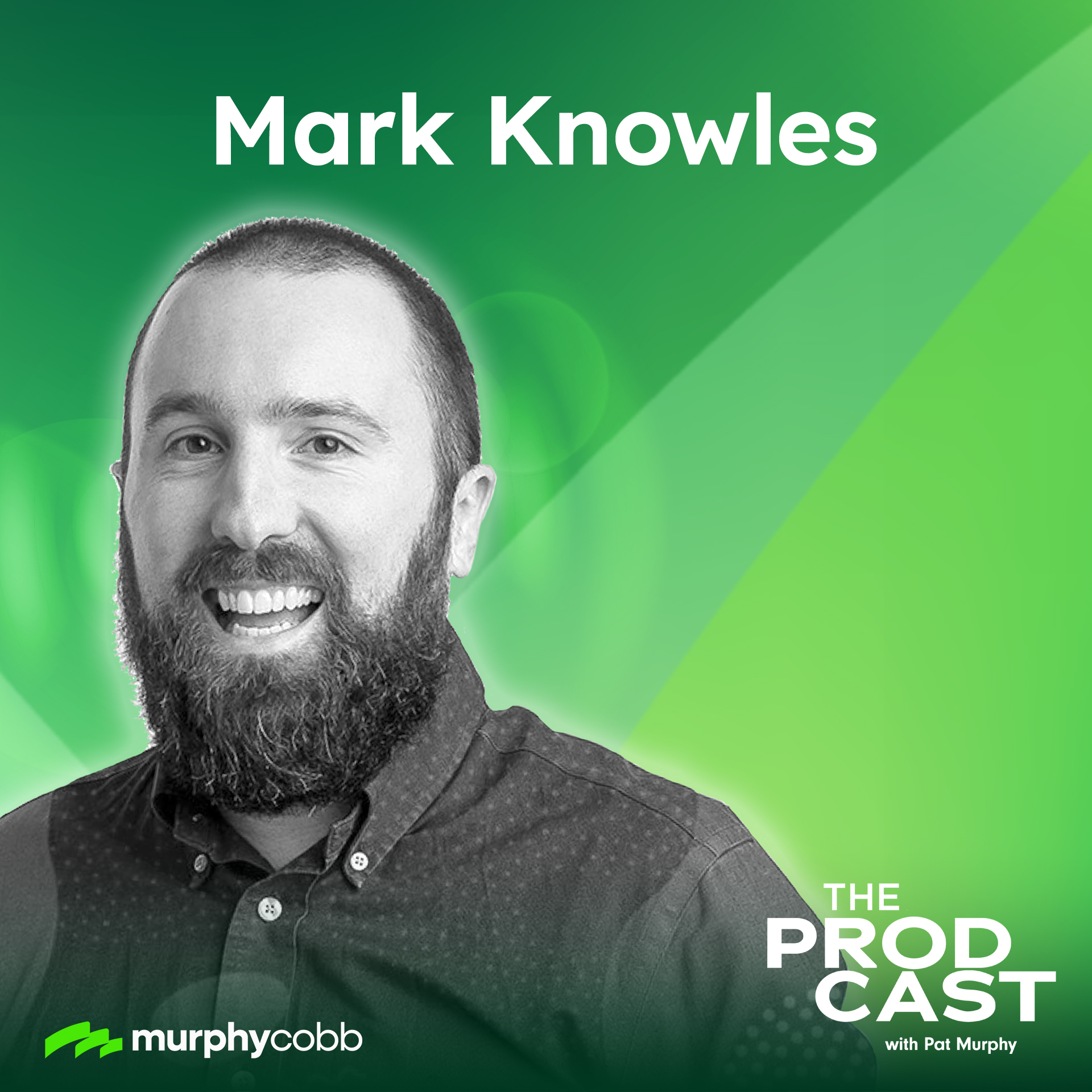
— Watch the Episode
— Show Notes
Intentional Human Friction: Knowing when to Zig and not Zag
This week on The MCA Prodcast, Pat Murphy is joined by Mark Knowles, Global Solutions Officer at dentsu, where he sits at the intersection of media, content, technology, and innovation. Having begun his career in CGI and visual effects, Mark moved to New York in 2012 to launch the Americas arm of Taylor James. He later joined Tag, where he led creative operations across the Americas before becoming CTO following dentsu’s acquisition in 2023, building the AI-native Content Engine designed to transform how global content gets made.
Mark and Pat consider the pros and cons of AI use in media production. Mark broadly agrees that the industry risks ‘scaling mediocrity’, producing a hundred forgettable variations instead of one great piece of work. His answer is ‘intentional human friction’. Because AI averages across everything and predicts the next token, it cannot produce the left-field idea that makes people stop. The human skill is knowing when to zig instead of zag, and the role of the production technologist is to design workflows that create space for that instinct rather than engineering it out.
The conversation also covers the broken world of the RFP. Mark argues that most pitches he sees are procurement-driven, which means they prioritise comparability over creativity, becoming ‘a race to the bottom’. A great RFP, he says, should feel like a consultation: “This is us as a brand. This is where we want to go. How do we get there together?” He also gets behind Pat’s theory that production could become the operating system for marketing, pointing out that unlike media strategies or creative territories, production is the only part of the chain that delivers something physical. That is precisely why it is uniquely placed to act as the connective layer across creativity, media, commerce, and performance.
See Mark’s favourite ad: John Lewis – Man on the Moon (2015)
Hosted by Pat Murphy
Connect with Murphy Cobb and The Prodcast:
Murphy Cobb & Associates | The MCA Prodcast | LinkedIn | Instagram | Email
— This Week's Guest
Mark Knowles
Global Solutions Officer - dentsu
— Mark's Favourite Ad
John Lews - #ManOnTheMoon (2015)
— Full EPisode Transcript - Expand to read and search
— Full EPisode Transcript - Expand to read and search
Pat Murphy
Hi, and welcome to The MCA Prodcast, your fix for everything innovative in advertising and production. I’m Pat Murphy, and I’ve been working in this industry for more than 35 years now. I’ve seen a lot of changes, but trust me, there’s plenty more around the corner. Each week on The Prodcast, you’ll hear from one of the movers and shakers shaping the world of advertising and production for the future. And we’ll dive into some of the key challenges facing our sector today and how we’re best placed to overcome them.
Today, we’re talking to someone who sits right at the intersection of production, technology, AI, and global transformation. Mark Knowles, Global Solutions Officer at dentsu. Mark has spent his career building the systems, workflows, and technologies that power some of the world’s biggest brands. At dentsu and TAG, he’s been instrumental in developing AI-enabled production ecosystems, connected content engines, and high-velocity workflows that are reshaping how global content gets made. He’s one of the clearest thinkers in our industry on what AI actually means for production. Not the hype, but the operational reality. And he’s a passionate advocate for the people, craft, and intelligence that sits behind the great work. Mark, thanks so much for joining me on The Prodcast.
Mark Knowles
Thanks, Pat. Thanks for having me. That was a big build-up. I hope I can deliver on that.
Pat Murphy
I have one first question that starts right at the beginning — what’s your title this week?
Mark Knowles
My title this week. Oh my goodness. It’s Global Solutions Officer, which is relatively all-encompassing.
Pat Murphy
Yeah. You keep changing your titles. What are you actually? Are you a creative technologist, a producer, a transformation specialist, just an anorak?
Mark Knowles
That’s a great question. I ask myself that often. Basically, I work with clients to figure out some of their biggest problems and come up with solutions that help them connect a lot of dots. That is the best way of describing it. Lots of conversations, lots of trying to keep up with the pace of things, and lots of transformation. It’s an exciting role. It’s never the same.
Pat Murphy
Now you started right at the very beginning, right on the ground floor, and then you’ve kind of worked your way up. How did you actually get into the business, for the benefit of young people coming into the industry? Where did you start and how did it grow?
Mark Knowles
Interestingly enough, I never knew that I wanted to go to university when I was at college in the UK. And then all my friends started going and I just started looking around to see what was out there. I was always really interested in the combination of practical things and technical things, and anything on the computer seemed like a little bit of a forte at the time. I was just thumbing through the prospectus of the University of Portsmouth, funnily enough. They had this computer animation course. I was looking at it and I was just fascinated by it. At that time it was kind of the rise of Pixar, and one of my favourite movies was Robots — I just loved the richness of the world they’d built. That was the start of it.
Once I’d graduated, funnily enough, it was a funny story. I’d applied for a company called Taylor James. One of the reasons I’d applied for them is that on their website they had these beautiful behind-the-scenes where you could go into the site and swipe across all of the work in progress — you could see the concept, the previews, and swipe across all of them. I used to spend hours on that. Anyway, I applied for the job and didn’t get it. They rejected me the first time. And then I went to the Isle of Wight and started making computer games for a living. Then I moved on from there, went back and applied for Taylor James again, and finally got the job. From there, that was the accelerant, I think.
The learning there is: don’t give up. Persistence always pays off. Because if I’d never gone back to Taylor James, I would never have been afforded any of the opportunities that I’ve had today. Especially when I moved over to the US to set up the Taylor James US operation with Glenn, who was the founder at the time. That was just meteoric and a huge accelerator for the acquisition by TAG as well. I just got to see so many things by persevering, you know.
Pat Murphy
And what have been the absolutely momentous moments during that path?
Mark Knowles
One of the first jobs I got when I went to Taylor James was a job for Rolex. They were sort of very anti-CGI at the time, but they really couldn’t get the quality of the lighting that they wanted. It’s so weird because that’s what they’re known for now. We’d done one of the first full CG ads for them.
What they used to do is put the watch on a gimbal, shine a light on it, spin it round, and just run the camera. Then they would basically see what they got and cut it together in the edit. They wanted this beautiful single camera fly-through of the watch to show all of the different pieces. What was really fascinating was that there were parts of the watch that they just hated — they would hate the oyster back on the back of the watch, they would hate some parts of the inside of the clasp. So they really wanted you never to show some of these things.
The cool thing was that at the office they’d sent us nine watches, which had to be locked in the safe every single day. At the time I was doing modelling, texturing, lighting, and shading in CG, and I had all of these watches on my desk. I was like, that’s the closest I’ll ever get to a Rolex. It was just kind of surreal. That was the first big job I think I’d ever done.
Pat Murphy
I was working on Rolex for JWT back a long, long time ago. I was the producer and I loved working on that account. They had a thing in those days whereby if you worked on the account for one year, you got a free Rolex. And I missed it by a day. So I never got my Rolex in the end. Anyway, it was great fun to work on. We did some fantastic recces at the carnival in Venice and stuff like that. It was great. Nice client. Beautiful work.
Pat Murphy
So you’re now the Global Solutions Officer at dentsu. It’s a title that sounds both exciting and somewhat mysterious. What does it actually mean? I know we talked about it a bit earlier, but does that mean you find it easy to solve a Rubik’s Cube?
Mark Knowles
I’d love to be able to solve a Rubik’s Cube, if you’re talking about superpowers. Really, my background — I sort of grew up through TAG, was the Chief Production Technology Officer at TAG. And then when we were acquired back in 2023 by dentsu, it became very evident that there was a lot of opportunity to combine a lot of the Media+ offerings. dentsu has this Media+ strategy — media plus something else, so media plus content, or CXM, or Creative, or Commerce, or Social. I sit at the intersection of media plus something else. A lot of that focuses on media plus content, because one of the things that has fascinated me throughout my career is that specifically at TAG, when we were an independent working with all the agencies, we never really got to see how the content performed. How did it work? We just made it and it went off into the world. You might see it on the big screen at some point, but you never really understood how it worked. That has been really fascinating for me, and it’s also just something that clients are asking us for all the time. So lots of that media plus content, and the performance of that content, is really interesting.
Pat Murphy
And TAG obviously is part of dentsu. Are you still inside that building or are you somewhere else now?
Mark Knowles
We are very much — we’ve sort of rationalised all our locations across the globe. It’s actually really nice because the team is getting to see a side of the agency world that they’ve never seen before, especially being around the creative teams in our New York office. It’s kind of exciting. We’ve definitely done the rationalisation piece. I’ve been in New York for the last 14 years. I have a wife and two kids, so I don’t think there’s any hope of me coming back. She refuses to drive on the other side of the road and she can’t drive a manual, so we’re not going to be doing that.
Pat Murphy
You’ve been very clear publicly about avoiding the AI hype train (inverted commas) focusing on operational AI. Now that’s much further away from the stuff that you used to do when you were at Taylor James. How do you feel about all of that? The handshakes, the handoffs, and the workflow.
Mark Knowles
I think it’s one of probably our biggest challenges as an industry. Everybody makes a digital banner or a TV ad or a social post. The reality is that we all do it differently. Every client’s slightly different, and trying to create a unified way of working is really challenging, especially when brands — back in the good old days — had three art buyers: a print art buyer, a digital art buyer, and a TV art buyer. Everything was very waterfall and very clear. Now, with this channel proliferation and explosion of different surfaces on which these brands have to talk, it’s just made it really difficult.
I’m a firm believer that marketeers are not really marketeers these days. They’ve become button-pushers. We expect them to go and spin up a schedule in an MRM platform and find things in a DAM. They want to be the CEO of their brand. They want to be meeting consumers where they want to play, they want to be evangelising their products. They just don’t get a chance to do that. A lot of that comes down to the operational burden of marketing and this explosion of content. So a lot of my focus is on how do we unburden the brand. How do we, as the agency, take on more of that responsibility for getting things over the line without creating so much admin.
It sounds like it’s a really unsexy part of it — I’d much rather be focusing on the creativity and the actual execution of the production. But sometimes we get in our own way. So a lot of my time is spent consulting with clients, figuring out where those handoffs and handshakes are, where those pain points are. And I think operational AI presents us with a quite unique opportunity to streamline a lot of that. It’s a fascinating space. But it’s not really the sexy stuff, is it?
It is not the sexy stuff, no. But it’s the one unifying thing that a lot of our clients have problems with. And it’s really difficult to solve because at the cornerstone of the problem is a little human resistance to change. I’ve gone through three different transformations this year, and three of those clients have commissioned third-party technology stacks designed to encompass their full end-to-end marketing ecosystem. Three of those things have failed. They’re not things that we’re managing, but they’re things that we are beholden to — we have to use these tools. A big part of the reason they fail is because you either don’t get the team on the ground involved in the discovery, or you don’t take them on the journey of change. There’s this natural resistance between global and local. A lot of my time is spent with global and local clients trying to build bridges between them. The perception is often that global’s a hammer and local’s a nail and everybody needs to be whacked, you know.
Pat Murphy
Do any of your team at the agency involve you in conversations using generative AI — not just operational AI — when it comes to solving problems in production?
Mark Knowles
Yes, we are finding more and more that especially when it comes to workflow design, one of the interesting things about AI is that as you build a bigger context — you bring in more of the brand’s ways of working, more of the interviews with the stakeholders, more examples of decks that they present or data that they have — the ability to connect the dots that maybe we don’t see is actually really insightful. It can find some interesting white space and highlight pros and cons of different approaches and solutions. So we’re using it more and more to battle-test solutions before we present them back to the client, looking across all of that context. And I think that’s creating some very different conversations than we would have had historically with clients.
Pat Murphy
What are you doing that’s better and smarter than the other holding groups or other agencies?
Mark Knowles
That’s a million-dollar question, Pat, because if we knew that we’d probably win every pitch. I think about dentsu — I spent some time in Japan at the start of the year. What struck me was just the heritage of dentsu, which is just phenomenal. 125 years, and in that 125 years they’d had — I think it was six CEOs or something — and they’d all been in tenure for like 20 years. They’d all had a moment that drove some form of first in the industry, some sort of transformation in the industry. And getting that heritage travelling west — that east-to-west thing — I think is really unique. A lot of other holding companies really struggled to break through in APAC and Japan. So I think that’s really unique to dentsu.
But I also think dentsu has a little bit of that Japanese integrity. They’re very transparent with clients as well. And I think that actually resonates in a moment where things are a little bit fuzzy. dentsu sort of stands out there, and it’s just a really enjoyable company to work for. The people are phenomenal. I think they genuinely want to do good. There’s something about that which I find quite admirable, you know.
Pat Murphy
Some critics argue that the rise of AI risks homogenising creativity, similar to how some data did. And in one of my last podcasts, with Nick Manning — who’s a kind of media guru in the industry — he said that we have potentially learned how to make bad advertising cheaper and quicker. Do you concur with that?
Mark Knowles
I saw that quote when you were posting it and I couldn’t agree more. It’s sort of scaling mediocrity, isn’t it? How do you avoid that? I think you have to have intentional human friction. From a creative perspective, the best ideas are the ones where you zig, not zag — that famous saying. But you have to have some form of intentional human friction to find a white space, to find the curveball idea. AI doesn’t do that. It sort of averages across all of the ideas. It’s that human intuition to look at a creative idea or a brief from a client and think, oh my god, this would be a great left-field idea. That’s really difficult for an AI to model, because literally it’s predicting the next token, and that next token is based on a dataset that is just the average of everything.
So for me, that human friction — we talk about this a lot as part of our technology stack — is where do we want to create intentional human friction? And I think that’s really the unlock when you talk about creativity.
Pat Murphy
So in the business of creating content faster and cheaper, which is what all clients want, where actually in the process, the stuff that you’re doing — where does AI actually genuinely help? And where is it still misunderstood?
Mark Knowles
I can tell you definitely where it’s misunderstood. In the early days, scale was like this sort of utopia of AI, but we weren’t acknowledging how deterministic this thing was. The repeatability just wasn’t there and it still isn’t there. We deal with automotive clients and a lot of them are trying to use AI on their vehicles, and all of a sudden their vehicles don’t look like their vehicles anymore — they’re missing a hubcap or a logo or a shutline somewhere. And I think it’s that level of nuance that clients have probably been oversold on.
We owe it to our clients not to oversell those solutions when we know they can’t achieve the end results they’re expecting. Because otherwise, cost just ends up going back into the pot somewhere. You make an AI image and then you’ve got to go back into post and fix it — you’ve not really made any savings. So there are a lot of challenges with the repeatability and predictability of these systems. In content production, we’ve got a ways to go before content at scale becomes a real thing.
That goes back to our point about mediocrity. Are you just scaling mediocrity by producing a hundred different ads? A lot of our conversations with clients at the moment are about not doing that. Not only are you scaling mediocrity, frankly, the media teams can’t traffic a hundred ads. There’s very little precedent to review and approve a hundred ads. When you’ve got a brand marketeer that’s already saturated in their day, they can’t approve a hundred ads. A media team can’t traffic a hundred ads. There’s a lot of work associated with that.
Where AI is genuinely helping is in the process pieces. It’s allowing our teams to refocus their attention on deeply understanding the brand, deeply understanding the strategy, better understanding the audience. Making sure we’re writing better quality copy — not necessarily using AI to write copy, but producing more variations that we can look across and test. Or more variations of an image that we can look across and say, okay, we’ve got more mood boards, more ideas. A lot of the time clients don’t know what they want when they submit the brief and they actually do want to see a spectrum of different ideas. Sometimes that’s where AI actually helps — almost in the pre-production phase of coming up with ideas. But we still need that intentional human friction in that process to filter out all the rubbish.
Pat Murphy
So let’s dig a little bit deeper into this conversation, because we see a lot of RFPs as well. But from your perspective, what does a great RFP look like?
Mark Knowles
I think a great RFP is a consultation. It’s more consultative — more about them saying: this is us as a brand, this is where we want to go, how do we get there? We know our brand best, you know how to advertise our brand best — how do we do this together? And it’s very rare for it to be issued like that. Because ultimately you’re trying to compare apples to apples, and in creating this sort of baseline across all of the different people that are responding, you’re actually losing some of the innovative thinking. Everybody’s trying to respond to this RFP and nail all of these points, but sometimes you just really need a left-field idea.
I also think procurement and brand are far too far apart. You can tell when an RFP is procurement-driven and when it’s brand-driven. And 75% of the RFPs we respond to are procurement-driven. This whole structure comes back to the CMO-CFO relationship, doesn’t it?
Pat Murphy
The RFPs that I’ve been involved in that I really love are where you have a very early opportunity to build a call with a potential client. You get in the room and it’s the chemistry. And if you have great chemistry with a client, everything else is fixable.
Mark Knowles
Completely. We did one with a client that took seven months, and it was probably one of the best RFP processes. You didn’t mind that it took so long because — exactly right — one of the first things they did was bring everybody into the room and do some chemistry sessions. I thought it was just a really beautiful way of starting out, because it actually made you want to go that extra mile every single time. You’d already built that chemistry with them. Rather than innovating in isolation, you knew what they wanted, you understood their pain points. It was really fascinating.
One of the quotes from that RFP: they had a real problem with global-to-local visibility of assets. The CMO had said: ‘We need to pivot our audiences into new products. Unfortunately, the local markets are incentivised to sell products that just sell. Those aren’t the new products. So we can’t see what they’re selling in those local markets, and it’s really difficult for us to pivot the brand into new audiences.’
And she said — and it’s a brilliant quote — ‘We get on a plane and we fly to a local market, and the only time we know what they’re serving up is when we get off the plane, we get hit with a cookie, and we see an ad from our brand. And then we realise that what we’re selling in that local market is not the new product.’ So this is a perfect problem statement for a lot of brands. It really framed the whole pitch we responded to — how do we become the bridge between global and local? And because we’d had that chemistry session where she’d said these things, we were actually able to respond in kind.
Pat Murphy
A couple of years ago, sustainability was a non-negotiable. It really was. And it seems to have just disappeared. AI isn’t in reality a sustainable production methodology at all. Think about all the energy to power those data farms and the water needed to cool them off. I’ve got a couple of stats: by 2030, data centres supercharged by AI are projected to consume around the same as the entire current electricity consumption of Japan. AI’s global water demand has been projected to reach 4.2 to 6.6 billion cubic metres by 2027 — roughly equivalent to half the UK’s annual water withdrawal. This subject gets no airtime right now, particularly around the conversation about AI. What’s your view? Because I have a passion for sustainability. We won the award for best practice in sustainable production a couple of years ago, and it doesn’t figure on the radar for a lot of clients right now.
Mark Knowles
We’re in a really interesting position, Pat, because of the TAG business. TAG actually has two sides of the business. They’ve got the content production piece, which is where a lot of the AI is surfacing. And they also have the channel activation and sourcing piece, which is all of the physical media — in-store, point of sale, and so on.
We’ve got a brilliant sustainability director, Emily Stilarcich. It’s her job to surface sustainability in the organisation. And it’s a constant topic of conversation specifically for us because of that side of the business. We’re also looking at dentsu — as I talked about integrity earlier — they believe it’s really important for us to reduce that carbon footprint. We have quite a lot of initiatives internally looking at our scope three emissions, looking at how we’re using AI, and how we quantify the impact of AI on production.
I definitely think it’s gone more internal, especially with geopolitical issues, especially in the US. The foot has been taken off the gas in general. Those conversations — similarly to DEI conversations — have somehow quietened down and disappeared, which is not a good thing. But internally, lots of that conversation is happening.
The reality of how it manifests and how we monitor it is key. Because lots of people are at very different stages of that process. As brands are starting to try to ramp up use of AI, they don’t really have that solid baseline understanding of what their emissions look like at the moment. It’s very difficult to create a baseline and compare where they are today versus where they will be if they use AI, and therefore quantifying the delta between the two is quite difficult. So Emily does a ton of work with clients just on quantifying that baseline. It’s quite fascinating when you see some of those readouts.
Pat Murphy
Doesn’t it come back to some of the hygiene factors? Just avoid the wastage. If you’re going to do a scatter-gun approach to making content, that’s going to cause an issue. Why don’t you just brief well and make only what you need?
Mark Knowles
Pat, have you ever seen a great brief? Because we talk about briefing all the time, and I reckon that 90% of the AI initiatives out there are probably briefing tools in some way, shape, or form. Because we all know it’s a problem. So, what does a good brief look like to you? I’m so curious.
Pat Murphy
You’re probably right. But some people do write great briefs, and particularly a lot of our clients that we work with — we have to educate them into that process as well. So we’ve added some extra really critical meetings that help that along. One of them is the production alignment meeting, which is a long, long time before we get into choosing anything. That’s good practice. I love a good brief.
Pat Murphy
Now, do you think we have a talent and skills issue in production today? Because there are still so many people who are working in a very old-fashioned way. What is it that these people can do to stay relevant? I pontificate on this quite a lot.
Mark Knowles
I go back to the consumer a little bit in terms of the skill gap. I think we’ve lost a bit of the focus on the consumer in advertising. We can tell a great story, but think about the way people consume content today — it’s just so vastly different from the way that we talk about it in advertising circles. I’m looking for a car at the moment. I’ve been consuming these one-minute YouTube shorts of this guy who basically does quick pans around the vehicle and shows all the features. And for me, that’s so different from the way I would have done that research years ago.
To stay relevant, you almost need to stay relevant to the consumer. You need to understand what their behaviours are, understand how content is changing, what’s resonating. It’s not just about resonating in pockets with Gen Alphas and Gen Zs and influencers and TikToks and stuff like that, but actually understanding the changes in things like commerce. The way that you buy a vehicle is changing — Tesla, you can go onto their website and hit order on a vehicle. That’s very different from going into a dealership and spending four hours trying to get a test drive and wasting half your weekend trying to buy a car. Our teams need to stay closer to those consumer trends and habits and bring those insights through to our clients, because that’s how you remain relevant.
On the flip side of that, there’s the technology piece, which is probably more directly the question you’re asking. You’ve got to play. You’ve got to play with this stuff. Two years ago, three years ago, I probably hadn’t ever played with an AI tool or technology. Today, I don’t know what I’d do without it. I use this tool called Whisperflow — I rarely type anymore on my computer, I just talk to it all the time. It gives me crazy stats at the end of the week, like ‘today you spoke 150,000 words’ — something obscene. But that gives me so many insights. You’ve just got to play with this stuff.
Pat Murphy
But stuff needs to be made, right? Ultimately there needs to be a producer to make this stuff. What in your mind makes a great producer today? Is it having the skills to make all of these different types of assets? Is it someone who has the great human skills to corral a number of troops? What makes a great production person?
Mark Knowles
Some of the best producers I’ve worked with — production’s hard. It’s actually quite difficult in the sense that you can be working long hours and you get last-minute changes. The best producers I’ve ever worked with are the people that can keep that energy up, keep that morale up, keep those feedback changes coming in, and everybody’s really positive and excited about it. Because we do our best work when we have a passion. Some of the best jobs I’ve ever done have been the free jobs, because you’re just so invested.
Those producers — they keep that momentum going, they keep that morale, they keep that energy high, they’re on top of everything. You don’t feel like you’re fighting the client, you feel like you’re in lockstep with the client, and everybody’s trucking towards the same goal. We had this fantastic lady Jess when we first moved over to Taylor James in the US. She was just a bundle of energy. I loved working with her.
Pat Murphy
Do you think a great producer is now really the third member of a creative team, with all of the stuff they need to handle?
Mark Knowles
I think if you’re talking purely about creative and production working together, yes. Them translating that creative into the production deliverables, being the interface between the creative teams and the production teams, is so critical. All of the agencies that we always used to work with as an independent — that producer-to-producer relationship was absolutely critical. It was always those two producers on either side of the fence that were critical to making sure that idea came to life in the right way and that nothing was missed. So yes, I would say that.
From what I’m seeing, there is a third wheel coming in, which is the media teams. And those producers — I think it’s really difficult for them to understand media as well. Media is just a different world. So it’s like there’s now an intermittent producer, a kind of fulfilment producer. How do you suddenly not just deal with a creative idea and how you produce it, but also understand the audience strategy, what channels they’re buying across, what the historic performance is? That’s a lot for somebody to absorb, and that’s tough.
Pat Murphy
Look, we’re in Cannes next week, both of us. And when this goes live, we’ll have been there, done it, and got the t-shirt, and had a couple of glasses of rosé along the way. What are you actually hoping for? And how will you know if your trip there has been successful?
Mark Knowles
Apart from meeting up with you and Mr Sikorski, of course — that’s probably going to be one of the highlights. I have a little bit of a love-hate relationship with Cannes, if I’m really open. I love the people, I love meeting the people, I love seeing what the latest trends are. But I almost think it’s lost its focus on creativity a little bit.
We were just doing our review the other day of all of the entries we’ve made at dentsu. We have this thing called reverse media schedules. It’s this idea that when you see a piece of rubbish in the world with a brand logo on it, that’s like the worst advertising for the brand in the world. So they’d actually paid the team to go out there using media dollars and pick up rubbish and remove it from the world. To me, that’s the stuff I want to see at Cannes. It’s all about sustainability, it’s all about brand good, and I feel like we’ve lost that a little bit because you get overwhelmed with the AI hype.
I just want to see great ideas that move me. Do awards still matter? I think they do. Without the awards, without the recognition for great work, it disappears. It’s really important that we recognise the value of great creativity. If we don’t, what are we striving to achieve? Otherwise it’s just: how efficiently did you buy a load of media, how much content did you make? That doesn’t matter, unless it actually moved somebody and made a difference in the world and drove some sort of outcome for the brand. I think you only get that when you really critically look at some of these things.
Pat Murphy
Pitching is expensive. We’ve had this conversation before, and agencies have talked about it a lot — how much time and money is invested in a pitch. It’s incredibly time consuming, sometimes it can take forever. If there are lots of suppliers, vendors, agencies involved in a pitch, your chance of success is pretty small. Often a lot of the thinking is given away for free as well. So what’s the right way for a CMO and their procurement partner to choose a production or creative partner today? Should they have a small pitch list? Should they be paying for the privilege of having companies on the pitch list? How should this work?
Mark Knowles
The industry has had a challenge with the pitch for the longest time because they feel like they’re giving away some of their IP — whether it’s a creative territory, a process, or technology that they’re showing. It’s challenging. I think the way that CMOs should evaluate pitches is based on a creative response — or a production response — to a specific ask. It’s one thing to go through all these operations, commercials, sustainability things, all the ancillary documents that justify who we are and why we’re an advertising agency. But I think it comes down to the quality of a response to a genuine brief. That should be the evaluation criteria that weighs highest.
A lot of the time these days, we aren’t seeing creative responses as part of these RFPs. Funnily enough, the ones we win more often are when there is a creative response. Audible — a couple of years back we responded to them and it was all about the creative response. Our deck just looked different because it was all framed around their brand and their idea — how do we bring this to life? When you don’t have that, it’s just a credentials deck. So for CMOs and procurement to come closer together, this all has to be framed around a reality.
Pat Murphy
I have a theory — you might have read that thing I posted a couple of weeks ago — about production potentially becoming the operating system for marketing. Or at least a more important operating system for marketing. It potentially has the opportunity to join all the dots of all the different platforms and systems — creative production, media, data, workflows, DAMs, commerce, and performance as well. Production could be the thing that joins it all up. I wrote it slightly controversially. But it could be, right? If people get it right. And I think I’m seeing that happen in a lot of the holding companies and agencies who understand where it’s all headed.
Mark Knowles
I think you might be right, Pat. I think about this a lot as well. Creative and media — those are actually quite subjective things. Production is a very physical thing. You end up with something you can physically hold at the end of it. You’ve got an asset. With media, you might have a media plan; with creative, you might have a creative territory — but those things are still incredibly subjective. Whereas production is a very physical thing. That’s why I think it’s very real, and that’s why I think it can be the glue that binds a lot of these things together. Because really, it’s the result of the output. We’ve always been at the bottom of the food chain from a production perspective, but we’re the only part of the food chain that actually delivers something. That’s why it can be the conduit for many things. And that’s why we’re seeing holding companies build those bridges between production and media and production and creative.
Pat Murphy
And what’s the one thing that you wish every CMO understood about modern production?
Mark Knowles
I want them to see the passion that goes into the production from the teams that do the work. I don’t think they see it. We’ve been pitching for a brand all weekend, and that team put their heart and soul into that pitch. They did it because they loved the brand. I just don’t think we evangelise that enough, you know.
Pat Murphy
You could have any job in the world tomorrow — what would it be?
Mark Knowles
I always wanted to be a police dog handler, Pat. That was my thing. When I didn’t get the job at Taylor James, I’d applied to become a police dog handler, and I didn’t get into the force in the UK. I was so disappointed. Maybe it was fate — maybe I was never meant to be that and was always meant to be in production. But that’s what I really wanted to do.
Pat Murphy
Your whole life is not in a straight line at all. It’s like a zigzag all over the place. And I kind of think that’s what makes life interesting.
Mark Knowles
Yeah, I think it’s beautiful. That’s why I love advertising. No two days are the same.
Pat Murphy
One of the things that no one knows about you is that you were nationally ranked in the UK as a table tennis player. Nationally ranked — was that like ranked 2,000 or something?
Mark Knowles
No, no. I was in the top 200. You’d actually think that’s quite a lot of people in the UK who play table tennis. We started up this coaching school in Southampton. It started out with eight kids in a church. I was one of the coaches, and in two years we had 110 kids, and one of them actually went on to become number one ranked in the UK. So I used to go around and play all these tournaments. I’d go with the kids, play the tournaments, my ranking would go up as well — and these kids were beating me left, right, and centre, and they’re 10 years old. But it was just so much fun to see them progress.
I used to play with Matthew Syed, who’s obviously a famous psychologist as well as a table tennis player. He set up a table tennis club on the Isle of Wight. So when I was over there making computer games, I played at his table tennis centre as well. It was a good time.
Pat Murphy
You still play?
Mark Knowles
I wish I could. Unfortunately not. I’ll give you a game though.
Pat Murphy
Oh, there we go. We’ll find a table in Cannes. Fantastic. Look, Mark, it’s been such a pleasure to have you here. I do have one final question to ask you — the one we always ask. To finish off, what’s your favourite ad of all time? And you can’t have made it.
Mark Knowles
I didn’t make it. I wish I had. I love The Man on the Moon, the John Lewis ad. The reason I love it is just because it’s a beautiful ad that makes you feel something. We’re in an age where we’re so disposable with the content that we create. I like an ad that makes me stop and think and get a little bit of goosebumps. And also the craft of that ad — the music, the cinematography. The story — just everything came together in that advertising process to make that ad, and it worked perfectly. I just think it’s beautiful.
Pat Murphy
Thank you so much. Look, I’m going to post that up on The Prodcast website so you can have a look at Mark’s favourite ad of all time. And Mark, oh my god, that was just so much fun. See you next week.
Mark Knowles
Yes, indeed.
Pat Murphy
Today we talked to Mark Knowles, a true innovator in global production and technology, and just a bloody nice guy. To find out more about The Prodcast, head to theprodcast.com where you’ll find details on all my guests, links to their favourite ads, and full transcriptions of every episode. If you have any comments, questions, or feedback, email us at podcast@murphycobb.com. I’m Pat Murphy, CEO of Murphy Cobb & Associates. Connect with us on LinkedIn or Instagram. All the links are in the show notes, and please like us on your favourite platform. Thanks again to Mark, the wonderful team behind the scenes, and our production partners at What Goes On Media. See you next time.